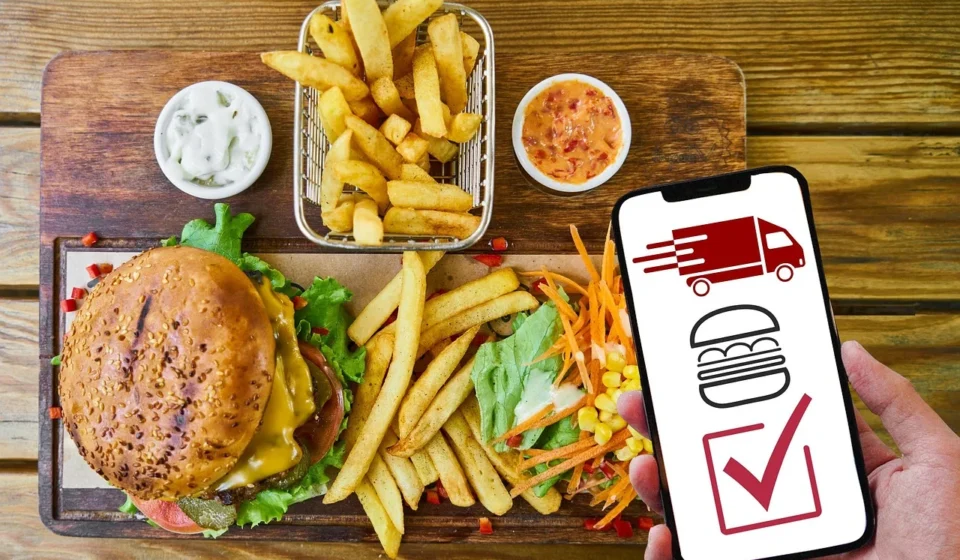
The Food Delivery Mobile App Development Cost ranges from $20,000 for a basic single-restaurant app to over $300,000 for a complex multi-vendor marketplace like Uber Eats. Most custom apps, including user, restaurant, and driver panels, cost between $70,000 and $150,000. This depends on features, team location, and chosen platforms.
Understanding your total food delivery mobile app development cost requires looking past initial design and software development. Ongoing operations, third-party API licensing, cloud server hosting, and app updates account for a significant portion of your multi-year budget. Evaluating these variables early helps you allocate resources effectively and prevent budget overruns.
Food Delivery Mobile App Development Cost by business model
Your chosen business model dictates your platform’s architecture. It also defines user flow and overall functionality. The global online food delivery market was valued at an estimated $288.84 billion in 2026. Grand View Research projects it will reach $505.50 billion by 2030. Therefore, your specific business structure defines which features you must build. This directly drives the final price tag.

- Aggregator Model (Multi-Vendor Marketplace): Platforms like Uber Eats or DoorDash require three interconnected apps. These are for the customer, restaurant, and courier. They also need an admin control portal. Total costs typically range from $90,000 to $250,000+. This is due to live logistics tracking, automated dispatch systems, and commission management.
- Single-Restaurant Model: You build this for individual eateries or local chains. This setup focuses on menu display and online ordering. It also offers simple payment integration and order status updates. Your overall food delivery app development cost for a single brand typically lands between $20,000 and $70,000.
- Full-Stack Meal Delivery Model: Meal kit services and ghost kitchens control preparation and delivery end-to-end. These apps require subscription scheduling, custom menu planning, and delivery route management, bringing development costs between $50,000 and $150,000.
Key cost breakdown by app component
A full-featured food delivery system requires separate applications tailored to each user type, all connecting to a backend server. The table below outlines typical development hours and costs based on an average agency rate of $50 per hour.
| App Component | Core Functionality | Estimated Hours (per platform) | Estimated Cost (at $50/hr) |
|---|---|---|---|
| Customer App | Account management, search filters, menu browsing, cart, payment, order tracking, reviews | 300–600 hours | $15,000 – $30,000 |
| Restaurant App | Order notifications, order status management, menu availability, earnings dashboard | 200–400 hours | $10,000 – $20,000 |
| Driver App | Profile verification, order acceptance/rejection, route navigation, earnings tracker | 250–500 hours | $12,500 – $25,000 |
| Admin Dashboard | Vendor management, commission tracking, system configuration, analytics, dispute resolution | 400–800 hours | $20,000 – $40,000 |
| Backend & APIs | Server architecture, database design, payment integrations, push notification infrastructure | 500–1000 hours | $25,000 – $50,000 |
What primary factors influence overall development expenses?
Understanding what drives custom food delivery app development expenses is helpful. It allows you to adjust project scope. You can do this before writing a single line of code.
- Feature Complexity: Advanced functionality adds substantial development hours. For example, AI-based dish recommendations add time. So do multi-stop delivery routing and automated courier assignment. In addition, real-time audio/chat support increases development hours.
- Development Team Location: Hourly rates vary dramatically by geography. For example, North American agencies typically charge $100–$180 per hour. Western European agencies charge $70–$120 per hour. However, teams in Eastern Europe and South Asia range from $30–$60 per hour.
- UI/UX Design Customization: Custom graphics, bespoke micro-interactions, and tailored user flows increase design effort. Off-the-shelf design templates lower costs but offer less brand distinction.
- Platform Choice: Building native iOS (Swift) and Android (Kotlin) apps separately doubles your frontend codebase. Cross-platform frameworks like Flutter or React Native let you share up to 80% of code. This reduces your total food delivery mobile app development cost.
Which technology stack delivers the best cost efficiency?
Your tech stack choice directly influences initial implementation costs, long-term stability, and server scaling fees.

Native versus cross-platform development
Native development yields peak graphic performance and deep hardware access. However, building separate iOS and Android apps pushes your total investment to $100,000–$300,000+.
Low-code and no-code tools
Platforms like Adalo or AppGyver allow low-cost prototypes. You can create these for $5,000–$20,000 using drag-and-drop elements. Using Low-Code/No-Code Platforms works well for proving local interest. However, these tools lack customization and security standards. Also, they do not support high-concurrency databases. Therefore, they cannot scale a multi-vendor delivery service.
What post-launch and ongoing costs should you expect?
Launching the app is only the first capital expenditure. Budgeting for post-launch operations is critical to prevent service disruptions.

- App Maintenance: Expect to spend 15% to 20% of your initial custom food delivery app development budget annually. This covers operating system updates, bug fixes, and security patches.
- Third-Party Service Fees: APIs for essential functionality incur recurring usage fees. These include Google Maps/Mapbox for location routing. Also, Twilio handles SMS verification. Stripe or PayPal process payments.
- Cloud Hosting & Infrastructure: Initially, hosting on AWS, Google Cloud, or Azure costs $100–$300 per month. However, this cost scales higher. It increases with active order volume and concurrent tracking connections.
- User Acquisition and Marketing: Reaching buyers and onboarding restaurants requires continuous digital marketing, local promotions, and app store optimization (ASO).
- Legal & Regulatory Compliance: Drafting terms of service, privacy policies, food handling compliance documentation, and data protection structures (GDPR/CCPA) requires legal support.
How can startups minimize initial app development costs?
Reducing your food delivery mobile app development cost requires smart scope management rather than cutting technical corners.
- Launch with an MVP: Limit your initial release to core workflows. These include restaurant listings, search, and ordering. You also need basic online payments and live GPS tracking. Defer loyalty points, advanced analytics, and custom rewards. Add these in subsequent phases.
- Use Established Third-Party APIs: Instead of building custom routing engines, integrate reliable APIs. For example, use Google Maps. Similarly, integrate Stripe and Firebase. This also applies to payment processing systems.
- Adopt Cross-Platform Frameworks: Use Flutter or React Native. This targets both iOS and Android. Consequently, you maintain a single code base. You avoid doubling your engineering effort.
- Follow Agile Methodology: Run 2-week development sprints with continuous quality assurance. This approach catches defects early and keeps features aligned with actual user demand.
How does the development timeline affect overall costs?
Because software agencies bill primarily by total development hours, timeline expansion directly inflates costs.
- Basic MVP App: Takes 3 to 5 months. Focuses purely on primary ordering and delivery management.
- Mid-Level Multi-Vendor App: Takes 5 to 8 months. Includes customized UI/UX, multi-payment options, driver auto-assignment, and rating systems.
- Enterprise Platform: Takes 8 to 12+ months. Features automated dispatching, multi-city expansion tools, custom CRM integration, and deep analytics.
What common budgeting mistakes should you avoid?
Avoid these common financial traps when planning your on-demand food delivery platform:

- Over-engineering the First Version: Packing too many non-essential features into version 1.0 drains capital before testing product-market fit.
- Ignoring Operating Expenses: Failing to reserve funds leads to cash crunches. This happens shortly after launch. Because you need to cover cloud servers, API calls, and customer support.
- Choosing Vendors Solely on Price: Selecting the lowest bidder often results in unmaintainable code, security flaws, missed deadlines, and eventual rebuilds that multiply initial costs.
- Vague Project Requirements: Incomplete specifications lead to scope creep and unexpected billing mid-project. Document all feature workflows clearly upfront.
Practical strategies for a cost-effective app launch
Achieving a high return on your food delivery mobile app development cost involves strategic operational decisions:
- Conduct thorough local market research to ensure your business model targets an underserved niche or delivery area.
- Partner with an engineering team that holds proven experience in on-demand software architecture and live location tracking.
- Establish clear performance metrics (KPIs) to track user retention, average order values, and delivery completion times from day one.
- Keep infrastructure scalable so backend services handle order spikes during peak dining hours without crashing.
You must carefully manage scope. Also, pick the right cross-platform tech stack. Prepare for recurring operational expenses. This ensures your food delivery venture launches on budget. So, it stays financially sustainable over time.
Frequently asked questions
How long does it take to develop a food delivery app?
First, building a basic food delivery app MVP takes 3 to 5 months. A feature-packed multi-vendor platform usually requires 6 to 9 months. However, a complex enterprise platform with automated logistics can take 9 to 12 months or longer.
What are the main components of a food delivery app system?
A complete food delivery system consists of four main parts. Customers use the Customer App for ordering. Restaurants use the Restaurant App for order acceptance. Drivers use the Driver App for navigation and delivery management. Finally, a Central Admin Panel oversees operations and finances.
Can I build a food delivery app on a tight budget?
Yes, you can build an initial platform on a tighter budget by launching a stripped-down Minimum Viable Product (MVP). Utilizing cross-platform frameworks like Flutter and existing third-party APIs helps keep initial food delivery mobile app development cost down.
What hidden costs should I be aware of?
Ongoing maintenance, cloud server hosting, third-party API usage fees (maps, SMS, payment gateways), app store publisher accounts, and customer support infrastructure represent recurring costs that extend beyond initial software development.
Is cross-platform development better than native development for food delivery apps?
How does the business model impact overall development costs?
Single-restaurant apps are the most affordable ($20,000–$70,000) because they handle simpler ordering flows. Multi-vendor marketplaces like Uber Eats cost significantly more ($90,000–$250,000+) due to real-time driver tracking, automated dispatch, commission splitting, and triple-app synchronization.