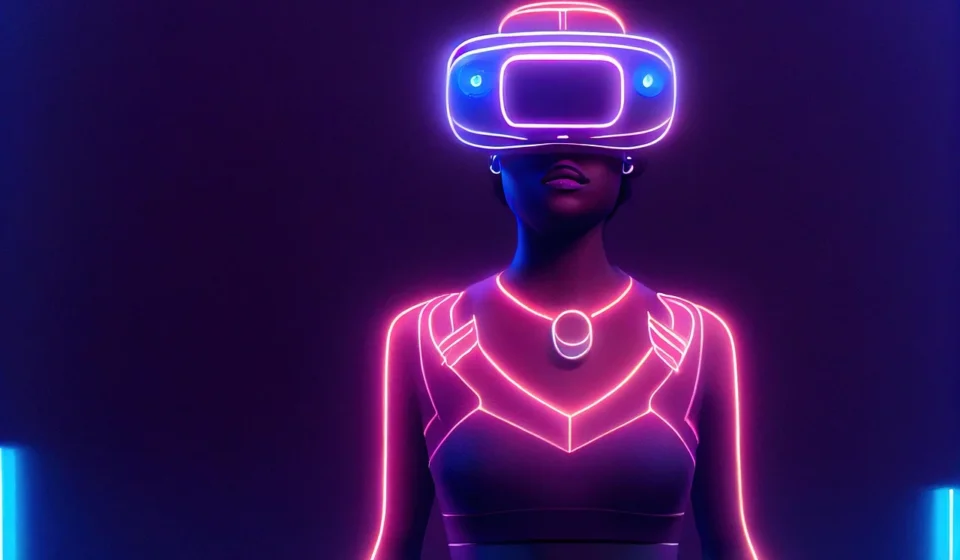
Augmented Reality (AR) and Virtual Reality (VR) are rapidly evolving technologies that businesses are increasingly adopting to create new efficiencies, enhance customer experiences, and unlock innovative opportunities. These immersive technologies are moving beyond gaming and entertainment, proving their value across various industries by offering practical solutions to real-world business challenges.
What Are Augmented Reality (AR) and Virtual Reality (VR)?
When people ask what AR and VR are, they are referring to two distinct but related immersive technologies. Augmented Reality (AR) overlays digital information onto the real world, enhancing your perception of reality. Think of it as adding layers of digital content – images, videos, 3D models – that you can interact with while still seeing your physical surroundings. This is often experienced through smartphone apps, smart glasses, or tablets.
Virtual Reality (VR), on the other hand, creates a completely immersive, simulated environment that transports you out of your physical surroundings. When you put on a VR headset, your senses are engaged by a computer-generated world, making you feel present within it. VR typically requires specialized headsets like the Meta Quest 3, HTC Vive, or Apple Vision Pro, offering a profound sense of presence and interaction within a digital space.

The core difference lies in their approach to reality: AR augments it, while VR replaces it. Both, however, offer powerful new ways for businesses to interact with data, products, and people.
How Businesses Are Using AR and VR Today
The use of AR and VR in business is incredibly diverse, spanning nearly every sector. From streamlining complex processes to creating memorable customer interactions, these technologies are proving to be invaluable tools. Here are some of the key applications:

Enhanced Training and Onboarding
AR and VR are transforming how companies train employees, especially for complex or hazardous tasks. Instead of traditional manuals or costly physical mock-ups, employees can practice in safe, simulated environments.
- VR for immersive simulations: For instance, medical students can perform virtual surgeries. Manufacturing technicians can also assemble complex machinery, or airline pilots can practice emergency procedures without risk. This hands-on, repetitive practice improves skill retention and reduces errors in real-world scenarios. This approach is particularly effective for roles requiring fine motor skills or quick decision-making under pressure.
- AR for on-the-job guidance: Field service technicians can use AR glasses to overlay repair instructions directly onto equipment they are working on, reducing downtime and the need for constant supervision. This means a less experienced technician can perform tasks that previously required an expert.
Immersive Product Design and Prototyping
Before AR and VR, designing new products often involved expensive and time-consuming physical prototypes. Now, businesses can iterate faster and more cost-effectively.
- VR for collaborative design reviews: Automotive companies, for example, can create full-scale virtual models of new car designs. Engineers and designers from different locations can meet in a shared VR space to inspect the vehicle from every angle. They can also test ergonomics and even simulate driving conditions, making real-time adjustments.
- AR for rapid prototyping: Architects can use AR to visualize building designs on a construction site. This helps them see how a new structure will fit into its environment before breaking ground. Furniture manufacturers use AR apps to let designers place virtual furniture pieces into a real room. So, they can assess scale and aesthetics instantly.
Revolutionizing Sales and Marketing
AR and VR offer novel ways to engage potential customers, allowing them to experience products before purchasing.
- AR for virtual try-ons and product previews: Retailers like Warby Parker allow customers to virtually try on glasses using their smartphone camera. IKEA’s Place app lets users virtually place furniture in their homes to see how it looks and fits. This reduces uncertainty for customers and can boost conversion rates.
- VR for experiential marketing: Travel agencies can offer virtual tours of hotels or destinations. This gives potential clients an immersive preview. Real estate agents use VR to provide virtual walkthroughs of properties. Also, this enables buyers to explore homes from anywhere in the world. Some companies even use AR for business cards. For example, scanning a card with a smartphone reveals a 3D model of a product or an interactive video presentation.
Streamlining Operations and Field Service
For businesses with complex operations or field service needs, AR and VR provide powerful tools for efficiency and problem-solving.
- AR for remote assistance: When a piece of machinery breaks down, an on-site technician can wear AR glasses and stream what they see to an expert located elsewhere. The expert can then draw annotations, highlight components, or overlay instructions directly into the technician’s field of view, guiding them through repairs step-by-step. This significantly reduces travel costs and resolution times.
- VR for facility planning: Manufacturing plants or warehouses can be designed and optimized in VR, allowing managers to walk through layouts, identify bottlenecks, and test workflows before any physical changes are made.
Engaging Customer Experiences
Beyond sales, AR and VR can create memorable and unique experiences that foster customer loyalty.
- Interactive brand experiences: Museums and tourist attractions use AR to bring exhibits to life with interactive digital content. They also use VR to transport visitors to historical events. Brands can create AR filters for social media. This allows users to interact with their products playfully.
- Personalized support: Some customer service applications are exploring AR. They help customers troubleshoot product issues by guiding them visually through steps on their own device.
Practical Steps to Integrate AR/VR into Your Business
Integrating AR and VR into your business doesn’t have to be an overwhelming leap. By taking a strategic approach, you can identify the most impactful applications and implement them effectively. My advice is to approach this systematically.

Identify Your Business Need and Use Case
Before investing in any technology, clearly define the problem you’re trying to solve or the opportunity you want to seize. Ask yourself:
- What specific pain points can AR or VR address in my current operations? (e.g., high training costs, slow design cycles, poor customer engagement)
- Which department or process stands to benefit most from an immersive solution?
- What measurable outcomes do I expect? (e.g.
Without a clear use case, you risk implementing technology for technology’s sake, which rarely yields positive results. For example, if your challenge is high turnover in a specific, repetitive assembly line role, VR training might be an excellent fit to standardize skills and reduce initial errors.
Start Small with a Pilot Project
You do not need to overhaul your entire business at once. Begin with a small-scale pilot project in a controlled environment. This allows you to test the technology’s effectiveness, gather feedback, and refine your approach before a wider rollout.
- Choose a single, well-defined use case with a limited scope.
- Work with a small team to develop and test the solution.
- Collect data on key performance indicators (KPIs) to evaluate success.
A common mistake here is trying to build a perfect, comprehensive solution from day one. Instead, aim for a Minimum Viable Product (MVP) that addresses the core need and can be iterated upon.
Choose the Right Technology and Partner
The AR/VR landscape is diverse, with various hardware (headsets, smart glasses, mobile devices) and software platforms. Your choice should align with your specific use case and budget.
- Hardware: For highly immersive VR training, a standalone headset like the Meta Quest 3 might be suitable. However, for mobile AR marketing campaigns, a solution using smartphones is more accessible.
- Software: Consider off-the-shelf solutions for simpler tasks or custom development for highly specialized needs.
- Development Partner: Unless you have in-house expertise, partnering with an experienced AR/VR development company is crucial. Look for a partner with a strong portfolio in your industry and a clear understanding of your business goals. They can help Handle the technical complexities and ensure a solid solution.
Focus on User Experience
Even the most advanced AR/VR technology will fail if it’s not intuitive and enjoyable for users. A poor user experience (UX) can lead to low adoption rates and wasted investment.
- Simplicity: Design interfaces that are easy to understand and navigate.
- Comfort: For VR, ensure headsets are comfortable for extended use.
- Relevance: Ensure the AR/VR content directly addresses the user’s needs or enhances their task.
- Feedback: Continuously gather feedback from users during pilot phases and iterate on the design.
The difference between a successful AR/VR implementation and a failed one often comes down to how well the user experience was considered and refined.
Measure and Iterate
Once your AR/VR solution is deployed, it’s vital to continuously monitor its performance against your initial objectives. This isn’t a one-time setup; it’s an ongoing process of refinement.
- Track KPIs: Are you seeing the expected improvements in training time, error rates, sales, or customer satisfaction?
- Gather User Data: Analyze how users interact with the AR/VR application. Are there common points of confusion or areas for improvement?
- Iterate: Use the data and feedback to make iterative improvements to the solution. Technology evolves rapidly, so be prepared to update and enhance your AR/VR applications over time to maintain their effectiveness.
Common Challenges and Who AR/VR Might Not Suit
While AR and VR offer significant advantages, they are not a universal solution for every business or problem. There are distinct challenges and scenarios where these technologies might not be the best fit.

- High Initial Costs: Developing custom AR/VR applications and acquiring specialized hardware can be a substantial investment. This is especially true for small businesses or those with limited budgets. For simpler problems, traditional solutions might still be more cost-effective.
- Technical Complexity and Expertise: Implementing and maintaining AR/VR solutions often requires specialized technical skills, from 3D modeling to software development. Businesses without access to this expertise, either in-house or through partners, may struggle.
- User Adoption and Training: Some users may be hesitant or uncomfortable with new immersive technologies. Therefore, ensuring proper training and demonstrating clear value are essential for successful adoption.
- Hardware Limitations: Current AR/VR hardware can have limitations in terms of battery life, field of view, resolution, and computational power. So, this might impact the effectiveness of certain applications.
- Motion Sickness: A small percentage of VR users experience motion sickness. This can be a significant barrier for applications requiring prolonged use.
AR/VR might not be suitable for businesses where the core problems are easily solved with existing, less complex technologies, or where the return on investment doesn’t justify the significant upfront and ongoing costs. For instance, if your primary goal is simple information dissemination, a website or brochure will likely be more efficient and accessible than a custom AR/VR experience.
The Future of AR and VR in the Business Landscape
The trajectory for AR and VR in business points towards continued growth and integration. As hardware becomes more powerful, lighter, and more affordable, and as development tools become more accessible, an explosion of innovative applications will be seen.

Expect to see more smooth integration of AR into everyday workflows, perhaps through increasingly sophisticated smart glasses that blend digital and physical realities almost imperceptibly. VR will likely continue to dominate in high-fidelity training simulations and collaborative virtual workspaces. The convergence of these technologies with AI and 5G connectivity will unlock even more dynamic and responsive immersive experiences, further cementing their role as indispensable tools for modern businesses.
Frequently asked questions
What does AR and VR stand for in business?
In business, AR stands for Augmented Reality, which overlays digital information onto the real world. VR stands for Virtual Reality, which creates a completely immersive, simulated environment, replacing the user’s view of reality.
What are common AR VR applications in business?
Common AR VR applications in business include immersive training simulations, virtual product design and prototyping, interactive sales and marketing experiences, remote assistance for field service, and engaging customer experiences like virtual tours.
How can a small business use AR and VR?
A small business can use AR and VR by starting with accessible applications like AR for virtual product try-ons via smartphone apps, creating interactive marketing content, or using VR for cost-effective employee training simulations for specific tasks.
What are the benefits of using AR and VR in business?
The benefits of using AR and VR in business include reduced training costs, faster product development cycles, enhanced customer engagement, improved operational efficiency through remote assistance, and the creation of innovative marketing opportunities that differentiate a brand.